|
||
36. Mosaic aggregates in a hexahedrite, "indicators of secondary processing" |
| Listing of Structures |
| Back...Next |
| Meteorite - Santo Antônio do Descoberto, IIAB Iron |
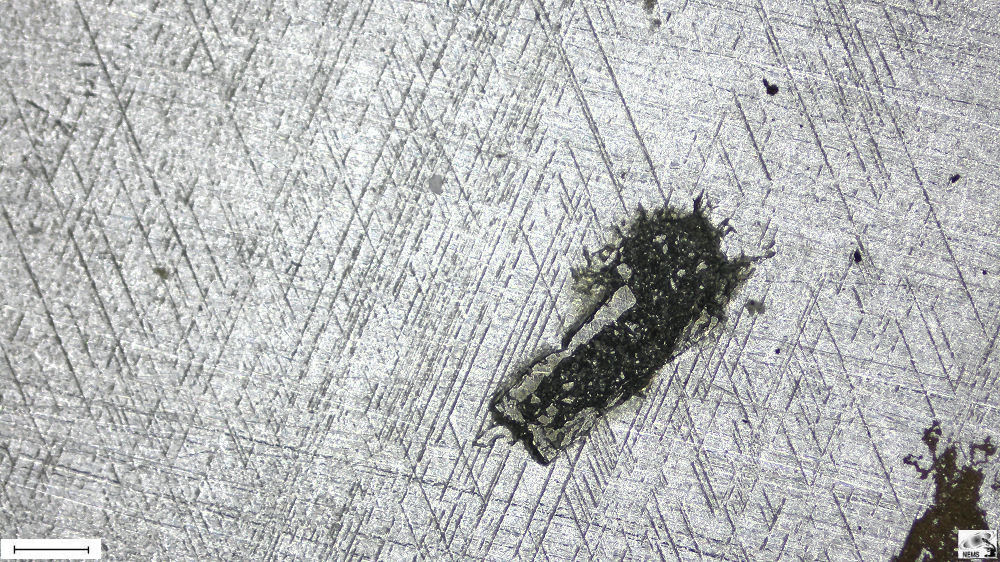
| Figure 1. Scale bar 150 µm. |
| Meteorite - Santo Antônio do Descoberto, IIAB Iron |
| Irregular troilite, daubreelite and metal mosaic aggregates. |
| Mosaic Aggregates in a Hexahedrite
Meteorite: Santo Antônio do Descoberto (IIAB iron, hexahedrite) Hexahedrites are a structural class of iron meteorites characterized by low nickel contents (typically 5.3–5.8 wt% Ni) and a predominance of kamacite (α-FeNi), the body-centered cubic (bcc) low-nickel alloy. They lack the prominent Widmanstätten intergrowth pattern seen in octahedrites and instead display relatively uniform kamacite grains, often interrupted by Neumann lines—fine, parallel deformation bands resulting from shock-induced twinning. Figure 1. Irregular troilite, daubréelite, and metal mosaic aggregates in Santo Antônio do Descoberto. Note abundant Neumann lines. Scale bar: 150 µm. Figure 2. Mosaic aggregates. Scale bar: 100 µm. Figure 3. Detail of irregular troilite, daubréelite, and metal mosaic aggregates. Scale bar: 30 µm. Mosaic Aggregates Santo Antônio do Descoberto exhibits prominent mosaic aggregates composed of irregularly shaped kamacite grains with varying crystallographic orientations, often associated with troilite (FeS), daubréelite (FeCr2S4), and other accessory phases. These aggregates interrupt the otherwise homogeneous hexahedritic texture and represent localized regions of recrystallization or shock-induced fragmentation and reannealing. Sulfides frequently occur as irregular nodules or aggregates within or adjacent to these mosaics, with evidence of localized shock melting in some areas. Formation and Interpretation Mosaic textures in hexahedrites typically arise as secondary structures from post-formation thermal and mechanical processing. A key mechanism involves shock heating above the α–γ (kamacite–taenite) transition temperature (~750 °C), followed by rapid cooling. This cycle causes the transformation of kamacite to taenite (or austenite) and back, resulting in polycrystalline aggregates with randomized orientations. Neumann lines record additional shock deformation that occurred after initial cooling on the parent body. Such features provide important evidence of the collisional history of the IIAB parent body, including impacts that induced localized melting, deformation, and annealing. The presence of shock-melted sulfides further indicates high-strain-rate events capable of mobilizing minor phases. |
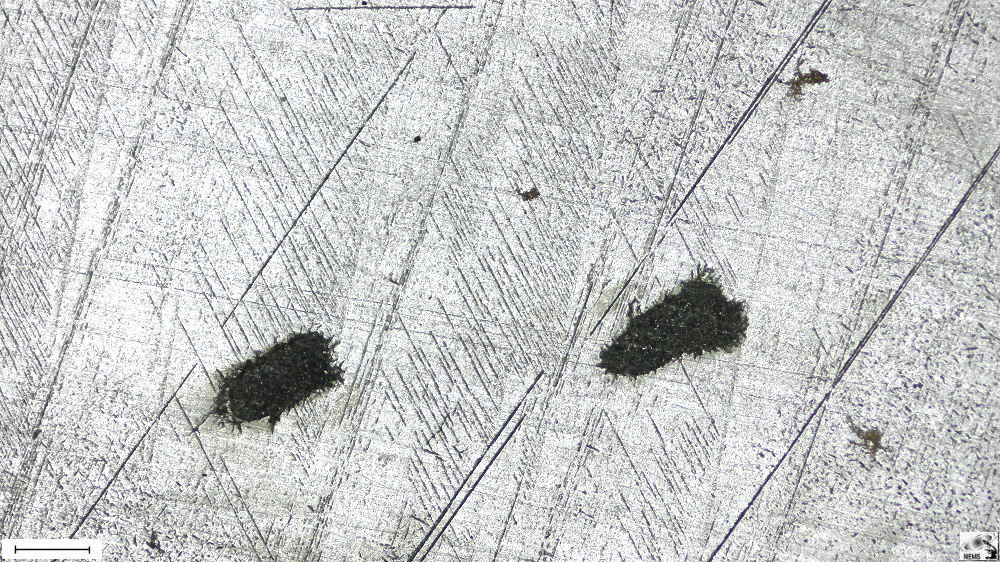
| Figure 2. Scale bar 100 µm. |
| Meteorite - Santo Antônio do Descoberto, IIAB iron |
| Mosaic aggregates. |
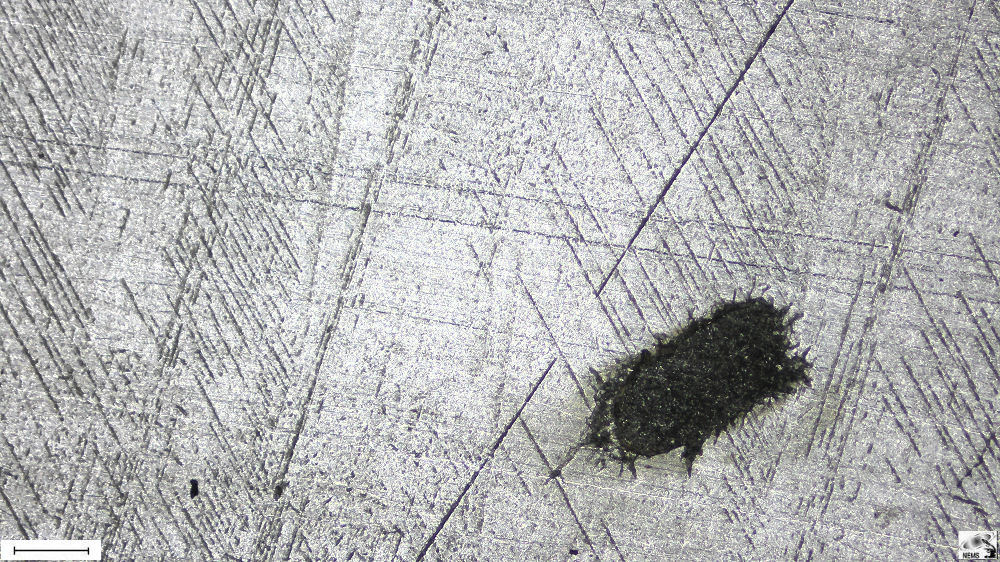
| Figure 3. Scale bar 30 µ. |
| Meteorite - Santo Antônio do Descoberto, IIAB iron |
| Irregular troilite, daubreelite and metal mosaic aggregates. |
| References • Meteoritical Bulletin Database (entry for Santo Antônio do Descoberto). • Buchwald, V. F. (1975). Handbook of Iron Meteorites. University of California Press. • General literature on hexahedrite petrography and shock effects (e.g., studies on Neumann bands and recrystallization in IIAB irons). |
| Listing of Structures |